October 09, 2026
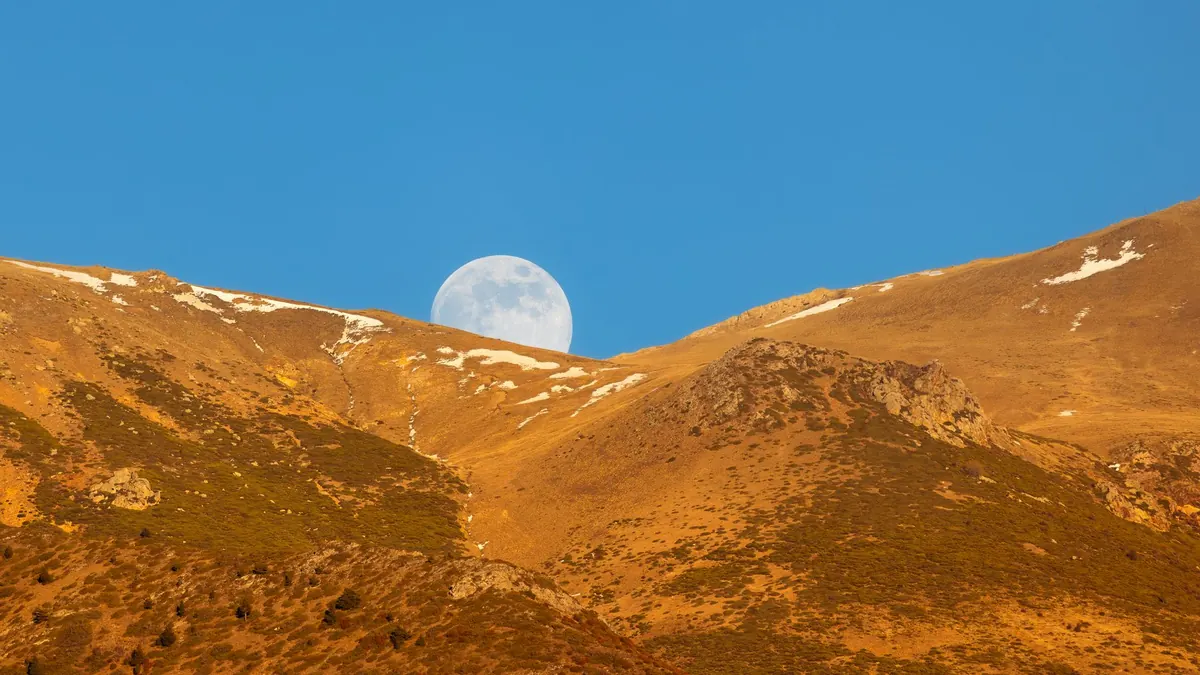
Stand outside just after moonrise and the Moon can look absurd: a huge, heavy disc wedged behind the rooftops. Two hours later it is a small bright coin overhead. Nothing about the Moon changed. Its distance has shifted only slightly, and it is the same object either way. What changed is the viewing conditions and, above all, how your visual system reads them.
The horizon moon illusion is one of the oldest puzzles in observational astronomy, and one of the few you can investigate yourself, tonight, without equipment. The answer is not a single elegant trick. It is a stack of small effects — atmospheric, geometrical, perceptual — that mostly point in the same direction.
What the Illusion Actually Is
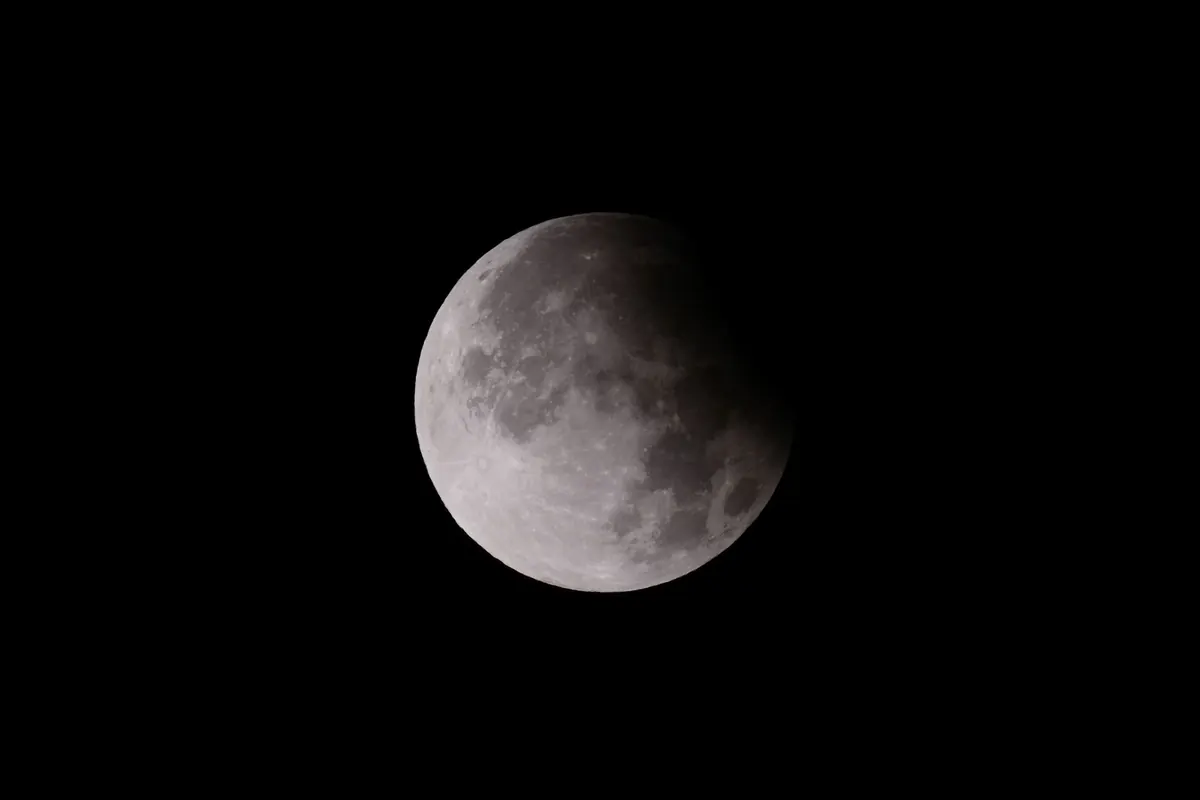
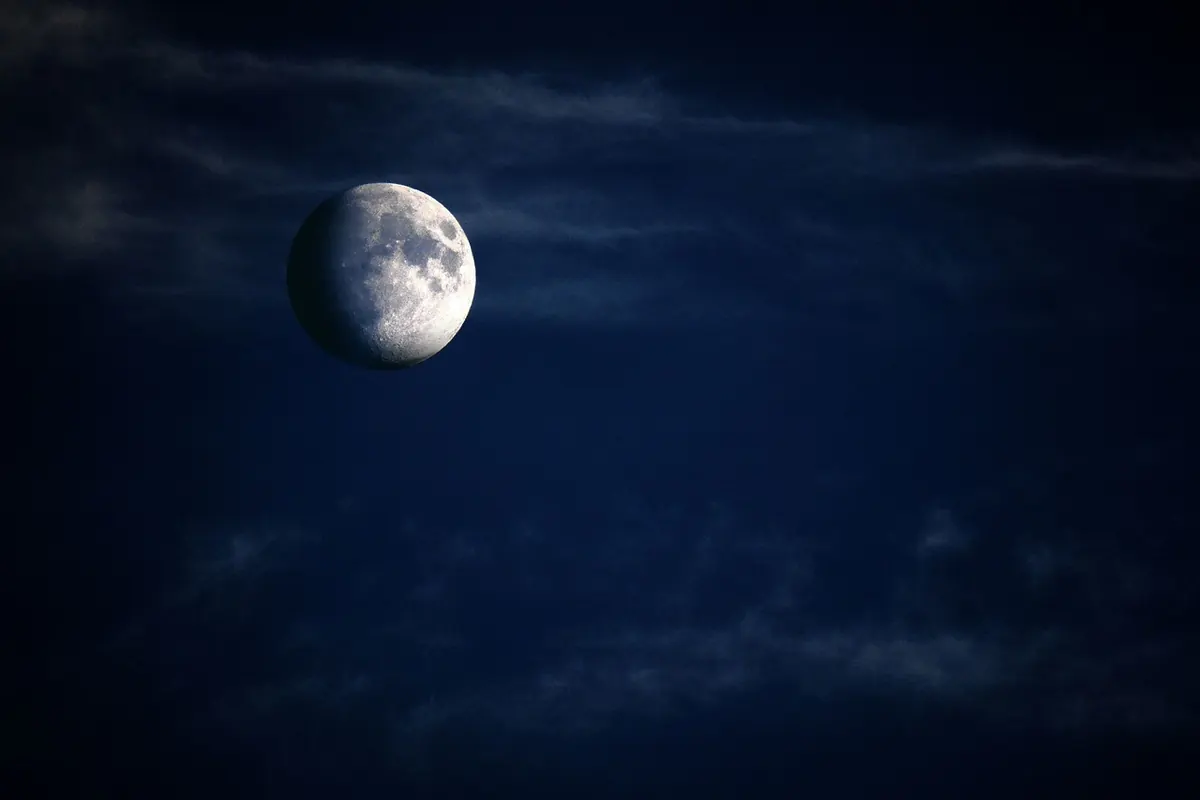
The Moon's angular size is remarkably stable: about half a degree across. That is roughly the width of your little fingernail held at arm's length, and it stays the same whether the Moon is rising over a hill or riding high in the dark.
So the retinal image is the same size in both cases. A camera confirms it. Point a phone at the Moon on the horizon, take a picture, then take another when it is higher, and compare the discs on screen. They will be nearly identical in pixel width.
What varies is your perception. Near the horizon the Moon seems to swell — sometimes to two or three times the size it appears overhead, though estimates vary wildly from person to person and from night to night. That gap between what the eye receives and what the mind reports is the illusion.
The Atmosphere Doesn't Magnify Anything
The most common guess is that the thicker air near the horizon acts like a lens and magnifies the Moon. It doesn't.
Refraction does bend light and lift the Moon's image slightly above its true position, which is why the Moon can appear to rise before it is geometrically above the horizon. Refraction also squeezes the disc, more at the bottom edge than the top, which is why a rising Moon often looks oval or flattened. That is distortion, not enlargement. The atmosphere makes the Moon a little squashed, never bigger.
The same thick slab of air explains the colour. Blue light is scattered out along the long path, leaving the orange-red that low Moons are famous for. Beautiful, but not a size effect. If anything, the extra air should make the Moon marginally dimmer and fuzzier, which it does.
Distance Is the Strongest Clue
Your brain does not measure objects in degrees. It estimates size after estimating distance, and it scales accordingly. A fixed angular size seen as "far away" gets interpreted as physically large. This is Emmert's law, and it does most of the work here.
When the Moon is low, it sits behind trees, chimneys, hills, streetlights. All of those are distance cues, and they put the Moon behind a landscape that your brain has already mapped as distant. When the Moon is high, it floats in featureless sky with nothing to anchor it, so the visual system treats it as closer — and therefore smaller.
The classic demonstration is the Ponzo illusion: two identical bars drawn over converging railway tracks, where the upper bar looks longer because the tracks imply it is farther away. The horizon Moon is that upper bar.
This also explains why the illusion is often weaker over open water or a flat desert. Remove the distance cues and the swelling largely goes with them.
The Sky Doesn't Feel Like a Dome
Ask people to point at the zenith and most will aim lower than straight up. The sky we perceive is not a perfect hemisphere but a shallow bowl, flattened overhead and stretched out near the horizon. If the horizon of your mental sky is farther away than the top of it, then a Moon near that horizon is registered as farther away — and scaled up again.
There is a second, subtler ingredient: how you hold your eyes. Looking at a horizon Moon requires almost no effort; your eyes sit level in their sockets. Looking up at a high Moon involves lifting the eyes and often tilting the head back, and the brain is poor at reading those angles precisely. Some researchers argue this miscalibration of eye position feeds directly into the size estimate.
You can feel this yourself. Stand with your back to the Moon, bend forward and look at it upside down between your legs. Many people find the illusion fades almost completely, because the familiar landscape cues and the usual upright posture are both scrambled.
Context and Relative Size
The Moon also looks big because of what it is next to. A disc half a degree wide is unremarkable against empty sky. Wedged between a roof ridge and a television aerial, it suddenly has something to be compared with, and those objects are known to be small. The contrast inflates it.
This is why photographs so often disappoint. The camera records the same half-degree disc, but a photograph strips away the depth and scale information your brain was using. The result looks like a small white dot pasted over a building, and photographers who want the picture to match the memory usually composite two exposures.
Five Ways to Test It Tonight
- The fingertip test. Hold your little finger at arm's length and line it up against the Moon. Note how much of the Moon it covers. Repeat when the Moon is high. It will be about the same.
- The photograph test. Take one picture at moonrise and one an hour or two later, with the same zoom setting. Compare the widths on screen. Same disc.
- The tube test. Look at the low Moon through a rolled-up sheet of paper or a cardboard tube that blocks out the landscape. With the surroundings gone, much of the swelling goes too.
- The slit test. Squint until the Moon is visible through a narrow gap between your eyelids, or view it through a gap between two fingers. Isolating the disc reduces the effect.
- The ruler test. Tape a ruler or a marked strip of card to a window frame at eye level and note where the Moon's edges fall. Do the same later from the same spot. The measurement barely moves.
While you are at it, try standing on your head, or viewing the Moon in a mirror. And compare notes with someone else — the strength of the illusion genuinely varies between people, and some report barely experiencing it at all.
Two Things Worth Knowing
First, the famous "supermoon." A full Moon at perigee is around fourteen percent wider than one at apogee — a real but modest difference, and one you would struggle to notice without a side-by-side comparison. The illusion routinely does far more than that, which is why so many "giant Moon" photographs are not quite what they seem.
Second, the Moon is not special in this respect. The same effect shows up with the setting Sun, with bright planets near the horizon, and with constellations, though we notice it most with the Moon because it has a visible edge.
Try This Tonight
Look up your local moonrise time and find a spot with a clear eastern horizon — a street with low buildings, a park, a shoreline. Arrive ten minutes early so you catch the Moon as it clears the rooftops, and do the fingertip test first, before you have time to think about it. Then look away, look back, and notice how the size seems to pulse depending on what you are comparing it to.
Take a photograph. Block the landscape with your hand and look again. Bend over for the upside-down view. An hour later, step outside and repeat the fingertip test against the high Moon, and you will have measured the illusion with nothing more than your own arm and a clear sky — which is exactly how it was first argued about, centuries before anyone could photograph it.
Photo: Marek Piwnicki / Pexels