October 29, 2026
In December 1972, Gene Cernan climbed the ladder of the lunar module Challenger for the last time, and no human has walked on the Moon since. Apollo did not end with a flourish so much as a shrug: budgets cut, hardware left over, three missions cancelled. Artemis is the answer to a question Apollo never had to ask — can you go back and stay? Comparing the two programs is not a matter of which was braver. It is a study in how the reasons for going changed, and how the rockets, the crews and the calendars changed with them.
More than half a century separates the last Apollo landing from the first Artemis one, and that gap is not a footnote to the comparison — it is the comparison. Apollo was a program with a deadline and a single, unambiguous finish line. Artemis is a program with a destination, a supply chain and an open-ended future, which makes it far harder to declare victory and much harder to keep funded.
What Each Program Was Built to Prove
Apollo began as a reply to a humiliation. In April 1961 Yuri Gagarin orbited the Earth, and within weeks John Kennedy told Congress the United States should land a man on the Moon before the decade was out. Everything else followed from that sentence: a narrow objective, a fixed date, and an engineering culture that treated the schedule as sacred. Science came along where it fit.
The numbers show how tight the brief was. Apollo 11's single moonwalk lasted about two and a half hours. By Apollo 17 the crews had a rover, three days on the surface and roughly 22 hours outside the module. Across six landings the astronauts brought home about 380 kilograms of rock and soil — a haul that rewrote planetary science and is still being picked apart in laboratories.
Artemis started from a different premise: not arrival, but repeatability. Under Space Policy Directive 1 in 2017 the United States set a goal of returning to the Moon with commercial and international partners, and eventually pressing on to Mars. That ambition is written into the architecture — a small station in lunar orbit, commercially built landers, a coalition of signatory countries under the Artemis Accords — and into the destination itself. Apollo went to the equatorial maria, where the terrain is flat and the light is predictable. Artemis is aiming at the south polar region, where craters in permanent shadow may hold water ice. That ice is the whole point: it is the difference between a visit and a base.
The contrast is easiest to see side by side:
- Objective: Apollo needed one successful landing before a political clock ran out. Artemis needs a landing that can be repeated, resupplied and eventually expanded.
- Duration: Apollo surface stays ran from a few hours to three days. Artemis is designed around longer stays, surface habitats and a pressurised rover.
- Partners: Apollo was a national effort run through contractors. Artemis blends NASA hardware with commercial landers and dozens of Accords signatories.
- Destination: flat equatorial plains versus polar terrain shaped by ice, permanent shadow and extreme cold.
The polar target changes the engineering as much as the politics. Sunlight at the south pole arrives at a shallow angle, so some crater floors have not seen direct sunlight for billions of years, and temperatures there drop below minus 200 degrees Celsius. Orbiting spacecraft have detected hydrogen signals consistent with water ice, and the LCROSS impact experiment in 2009 threw up material containing water vapour. None of that makes landing easier than it was in the Sea of Tranquility: the light is harsh, the shadows are deep, and the most valuable resources sit inside the coldest places on the Moon.
The Hardware Gap: Analog Courage, Digital Systems
Two big rockets, two different bets
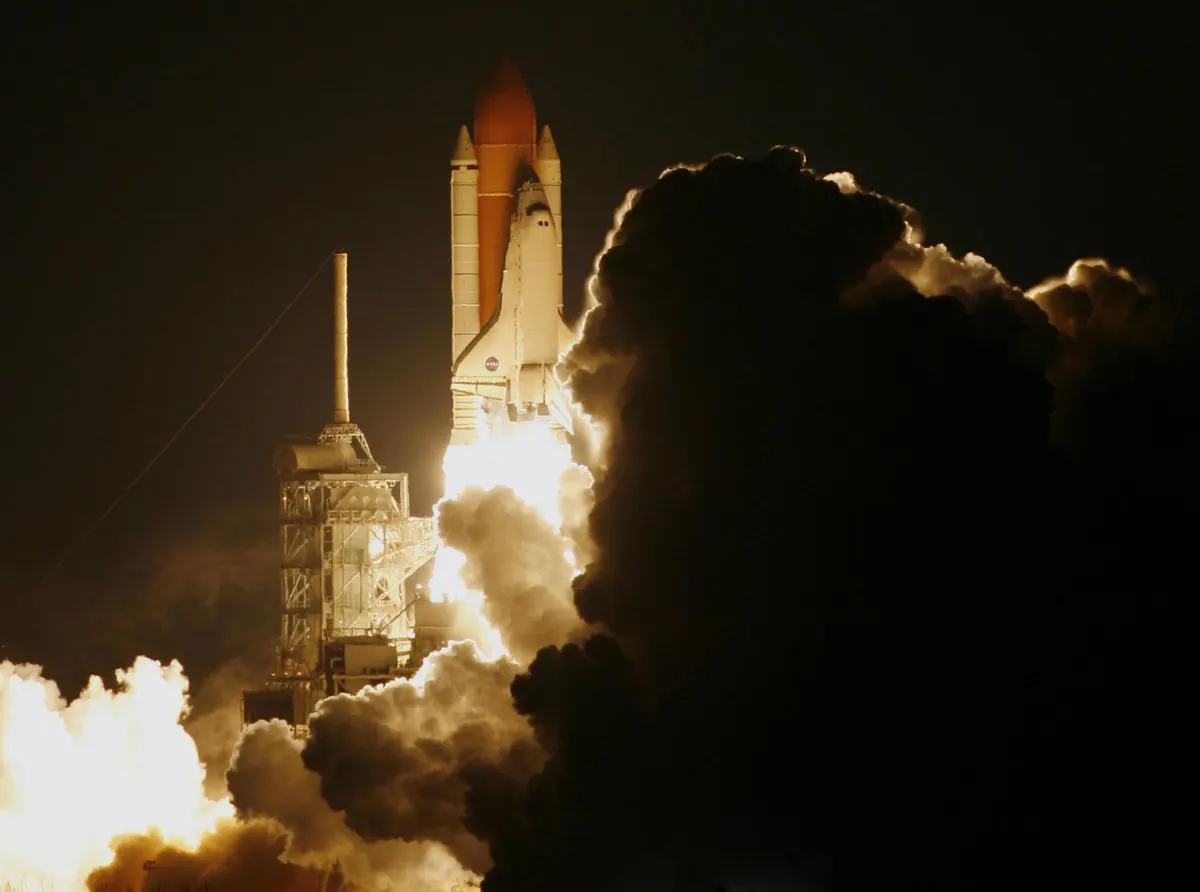
Saturn V stood about 110 metres tall and produced roughly 7.6 million pounds of thrust at liftoff. The SLS Block 1 flying today is about 98 metres and pushes past 8.8 million pounds. Both are expendable, and both lean heavily on earlier engineering — the SLS core stage uses Shuttle-era main engines and solid boosters, much as Saturn drew on the von Braun team's prior work.
The real break is in the mission design. Apollo launched the command module, service module and lunar module on a single Saturn V. Artemis launches Orion on SLS and then relies on a separate commercial lander, sent up on another rocket, to meet the crew in lunar orbit. That one change reshapes the entire program: more players, more docking, more places for a schedule to slip.
It also changes what the spacecraft are for. Apollo's command module was a cramped capsule for three people on a trip measured in days; Orion carries four and is built to loiter in lunar orbit for weeks, including time uncrewed while a crew works on the surface. The landers are a bigger departure still. The lunar module was a purpose-built, two-stage vehicle of about 15 tonnes. Current Artemis lander concepts are far larger, and SpaceX's Starship Human Landing System depends on orbital refuelling — a capability never yet demonstrated at the required scale.
The cockpit
The Apollo Guidance Computer was a marvel of its moment and a museum piece by any later standard. Its programs lived in core rope memory, physically woven by hand, and crews entered commands through a keypad using a verb-noun code. Navigation leaned on a sextant and star sightings, cross-checked by radio tracking from the ground. The whole machine had roughly 72 kilobytes of memory and a clock speed of about two megahertz.
What that hardware produced, though, was flying of a very high order. During the Apollo 11 descent the guidance computer began throwing 1202 program alarms as it shed low-priority tasks; controllers in Houston recognised the pattern and let it run, and Armstrong took semi-manual control in the final seconds to steer clear of a boulder field. Those calls were made with almost no margin and very little data.
We choose to go to the Moon in this decade and do the other things, not because they are easy, but because they are hard.
Orion's cockpit is a different species: glass displays, software-driven fault management, autonomous navigation and vastly more computing power than Apollo's entire ground infrastructure. The irony is that manual flying skill still matters. Artemis II is planned as a free-return trajectory around the Moon — a profile that deliberately echoes Apollo 8 — partly to prove the life-support and heat-shield systems before anyone commits to a landing.
The Human Factor: Crews, Risk and Time
Apollo crews were three men, almost all military test pilots, drawn from a small pool and trained to operate their systems by hand. Artemis crews are four, drawn from a wider pool that includes scientists and international partners, and NASA has committed to putting the first woman and the first person of colour on the surface. That is a real change in who goes, and it follows from a change in who is paying and who is signing the Accords.
Risk is handled differently too. Apollo accepted risk at a pace that looks reckless in hindsight — Apollo 1's fire killed three astronauts on the pad, and Apollo 13 nearly killed three more. Artemis inherited a safety culture shaped by those losses and by two shuttle accidents, which means more uncrewed test flights and longer reviews. Artemis I flew without a crew in 2022, and its heat shield returned with unexpected char loss that took months to explain.
Mission length raises medical questions Apollo never faced. Radiation exposure on a long stay, the effect of partial gravity on bone and muscle, and the strain of a small crew in a distant outpost are all active research areas. Apollo answered whether humans could survive a trip to the Moon. Artemis has to answer whether they can live there.
The Bill and the Cadence
Apollo's peak spending reached roughly 4 per cent of the federal budget; the program cost about $25 billion in 1960s dollars, well over $250 billion today. It bought a national capability and then was largely dismantled within a few years of the final landing.
Artemis is funded through a different model. NASA's inspector general has put the cost of a single SLS/Orion launch at around $4 billion, and the program's annual budget runs into the billions. The commercial lander contracts are fixed-price awards, which shifts some risk to the companies but leaves the schedule hostage to their progress. Congress, meanwhile, has consistently protected the rocket and capsule even while questioning the architecture around them.
Cadence is where the two programs diverged most sharply. Apollo flew six landings in under four years, with missions roughly every six months at its peak. Artemis is currently aiming at something closer to one flight a year. A program that flies once a year is not yet a program that stays; it is a series of expensive demonstrations. A base requires launch rates, supply chains and surface infrastructure that Apollo never had to build.
What to Watch
The next few years will answer most of the open questions:
- Artemis II: a crewed lunar flyby, no earlier than 2026, testing Orion's life support and heat shield end to end.
- Artemis III: the first landing attempt, currently no earlier than 2027, dependent on a commercial lander and on orbital refuelling demonstrations.
- Gateway: the station's first modules, which decide whether Artemis has a permanent orbital foothold or just a series of visits.
- Ice prospecting: the CLPS landers and rovers heading for the south pole, which will show whether the water-ice case is as strong as orbital data suggests.
The fairest comparison, in the end, is not between rockets or crews. Apollo was a demonstration of what a nation could do once, with a deadline and a blank cheque. Artemis is an attempt to build something that does not end when the political weather changes. Measured against Apollo's single soaring goal, Artemis looks slow and untidy. Measured against the question it was built to answer, it is the harder program — and the one whose success will be judged long after the first crew steps out onto the polar dust.
Photo: Pixabay / Pexels