October 27, 2026
A lunar eclipse rewards patience. You can watch it from a garden chair, with no filter, as the Moon slides into Earth’s shadow. A solar eclipse asks for something different: planning, travel, and a strict respect for your eyes. The two events are often mentioned in the same breath, but they are not variations on one theme. They are opposite geometries, different experiences, and they come with different rules. Here is the simple comparison.
If you are new to Moon watching, the first thing to understand is that one eclipse is about the Moon entering Earth’s shadow, while the other is about the Moon’s shadow entering Earth. That single difference explains almost everything else: why lunar eclipses are visible from half the planet, why solar eclipses are visible only along a narrow track, why one is safe to stare at and the other is not, and why one feels like a slow reveal while the other feels like a brief, high-stakes event.
The Geometry: Two Different Shadows
Both eclipses depend on a near-straight line of Sun, Earth, and Moon. The difference is where the shadow falls.
During a lunar eclipse, Earth is in the middle. The Sun is behind Earth, and the Moon is on the other side, so the Moon passes through Earth’s shadow. This can only happen at full moon. Earth’s shadow is wide enough to cover the Moon completely, which is why a total lunar eclipse is possible. The shadow has two parts: the penumbra, where sunlight is only partly blocked, and the umbra, where direct sunlight is fully blocked. A lunar eclipse begins when the Moon enters the penumbra, becomes obvious when it enters the umbra, and reaches totality when the entire lunar disk is inside the umbra.
During a solar eclipse, the Moon is in the middle. The Moon passes between Sun and Earth, and its shadow falls on a small part of Earth’s surface. This can only happen at new moon. The Moon’s shadow is narrow, so a total solar eclipse is visible only along a limited track. That track might be roughly 100 to 200 kilometers wide in many cases, though the exact width varies. Outside the track, observers see only a partial solar eclipse, and the farther they are from the track, the less of the Sun is covered.
Why not every month? The Moon’s orbit is tilted by about five degrees to Earth’s orbit around the Sun. Most new moons and full moons miss the alignment. Eclipses come in seasons, when the geometry lines up closely enough. That is the whole trick: alignment, not just phase. The Moon must be at the right phase and at the right place in its orbit. When those two conditions meet, we get an eclipse season, usually two or three eclipses in a row.
A useful way to picture it is to imagine a long, flat table for Earth’s orbit and a slightly tilted plate for the Moon’s orbit. The two plates cross at two points called nodes. An eclipse can only happen when the Moon is near a node at new moon or full moon. If the Moon is at new moon but far from a node, its shadow misses Earth. If it is at full moon but far from a node, it misses Earth’s shadow. The tilt is small, but in orbital terms it is enough to keep most months eclipse-free.
A Lunar Eclipse: Slow, Safe, and Often Red
A lunar eclipse is the easier event for a Moon watcher. You need a clear sky and a view of the Moon; you do not need to travel to a narrow path. Anyone on the night side of Earth who can see the Moon can watch. That can mean an entire continent, or even more, sharing the same event. Weather is still the great filter: a perfectly placed observer under clouds sees nothing, while someone hundreds of kilometers away may get a perfect view.
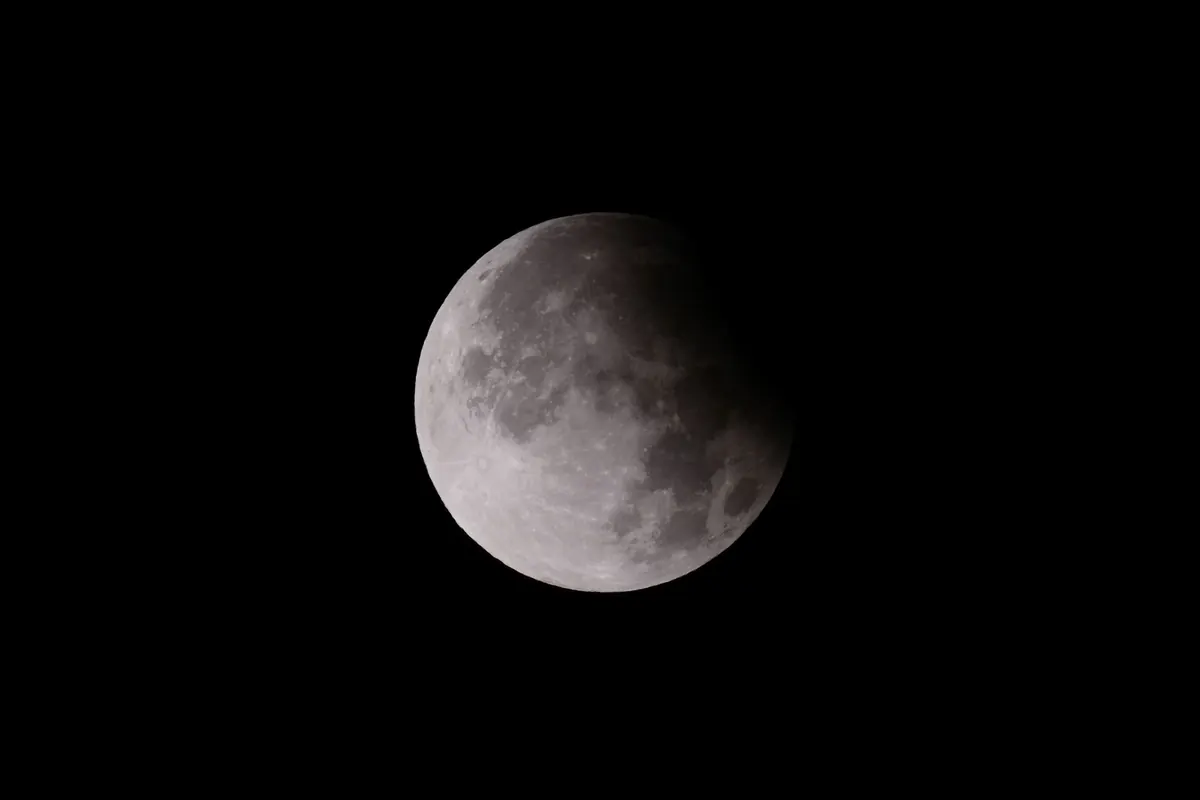
The event unfolds in stages. A penumbral eclipse is subtle: the Moon dims slightly, and you may not notice unless you know what to look for. A partial eclipse is more obvious: a dark, curved bite seems to take a piece out of the Moon. A total eclipse is the main event. The curved edge of the shadow is a visible reminder that Earth is round, and it moves slowly enough that you can watch it creep across individual craters and maria.
The pace is gentle. The whole event can run several hours, and totality itself can last more than an hour. That gives you time to watch the shadow creep across craters, take a break, and come back. Binoculars or a small telescope add detail, but they are optional. In fact, some observers prefer the naked-eye view because it shows the whole Moon and the color of totality at once. A camera on a tripod can capture the sequence, but the experience is not a race.
Why the Moon turns red
During totality, the Moon does not go black. Sunlight passes through Earth’s atmosphere and is bent into the shadow. Blue light is scattered away; red and orange light reaches the Moon. In effect, you are seeing every sunrise and sunset on Earth at once, projected onto the lunar surface. The color can range from dull brown to bright copper, depending on dust and clouds in Earth’s atmosphere.
That is why no two total lunar eclipses look exactly alike. After a major volcanic eruption, fine dust in the stratosphere can make the Moon darker and more brownish-red. In a very clear atmosphere, the Moon can glow a vivid orange or copper. Observers sometimes use the Danjon scale, a simple five-point rating from very dark to bright, to describe the color. You do not need the scale to enjoy the view, but it is a nice way to compare one
Photo: Jozef Papp / Pexels