October 26, 2026
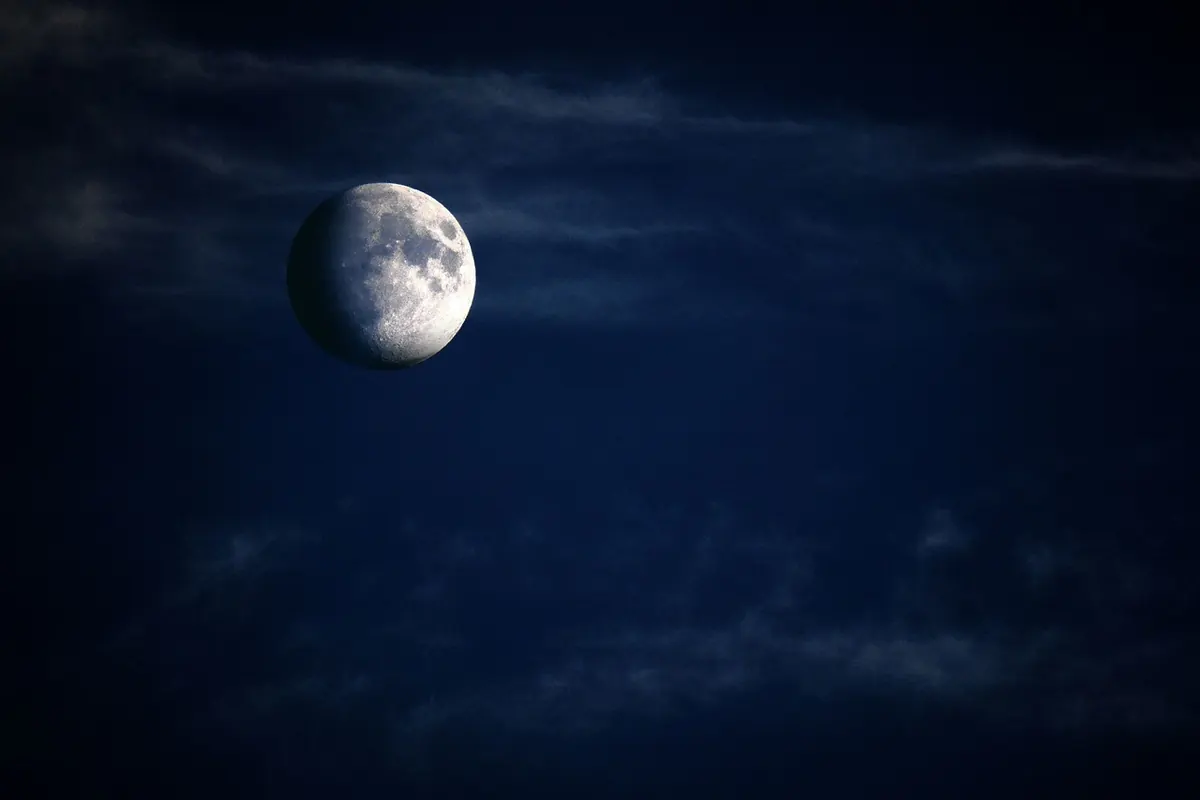
The Moon is the one object in the night sky that rewards a fifteen-minute glance. No telescope, no drive to dark skies, no equipment beyond a jacket. Step outside, find it, and something has changed since the last time you looked. Over roughly 29.5 days it runs the whole cycle from invisible to full and back again, and every one of those nights offers something worth noticing. What follows is a walking tour of that cycle: what to look for, roughly when to look, and which details are easy to miss.
Learn the Two Directions First
Before the nightly tour, one piece of geometry saves weeks of confusion. The Moon is not changing shape. Half of it is always lit by the Sun; we simply see that lit half from different angles as the Moon orbits us. Phases are a viewing angle, not a shadow cast by the Earth — that only happens during a lunar eclipse.
The practical upshot is that you can always tell where you are in the cycle by asking which side is lit. In the Northern Hemisphere, a Moon lit on its right side is waxing — growing toward full. A Moon lit on the left is waning — shrinking toward new. (In the Southern Hemisphere this is mirrored, and near the equator the crescent sits more like a smile.)
Second useful habit: find the terminator, the line between lunar day and lunar night. That ragged boundary is where the Sun is low in the lunar sky, throwing long shadows. It is where the Moon looks three-dimensional, and it is where you should aim your attention every single night.
Days 1–7: The Crescent and the Da Vinci Glow
A day or two after new moon, the Moon is a thin sliver low in the west just after sunset, following the Sun down within an hour or two. It is easy to miss and worth the effort. Look for it about 20 to 40 minutes after sunset, when the sky is still blue rather than black; binoculars help you pick it out of the glare.
Here is the reward. On a young crescent, the unlit part of the disc is not completely dark. It glows faintly, grey-blue, because sunlight is bouncing off Earth's clouds and oceans and onto the lunar surface. This is earthshine, sometimes called the Da Vinci glow. It is strongest in the days around a thin crescent and nearly invisible by first quarter.
By day 7 or 8 the Moon reaches first quarter — a clean half-disc, highest in the sky around sunset and setting near midnight. The terminator runs almost straight down the middle, which means the craters along that line are at their most dramatic. This is the single best night of the month for a first look through binoculars.
Days 8–14: Follow the Terminator
From first quarter to full, the illuminated portion grows into a gibbous shape. The terminator creeps westward across the disc by roughly twelve degrees of lunar longitude each night, which means the same crater can look utterly different 24 hours apart.
Some landmarks to catch on the way:
- Days 8–10: the smooth dark plains of the Sea of Tranquility and the Sea of Serenity, with the bright, rugged Caucasus and Apennine mountains catching the light at the edge of the shadow line.
- Days 9–11: Copernicus, a bright crater with a cluster of central peaks and a halo of rays, sitting alone in the grey plains. It looks like a splash frozen mid-bounce.
- Days 10–12: Plato, a dark, smooth-floored crater near the top edge of the disc, and Clavius in the bright southern highlands, a huge walled plain studded with smaller craters.
Aim for the nights when a feature sits right on the terminator. That is when crater rims throw shadows long enough to see in a cheap pair of binoculars. Two nights later the same crater will look flat and washed out.
Days 15–21: Full Moon and the Waning Landscape
Around day 14 or 15 comes full moon, rising roughly as the Sun sets and staying up all night. Many observers dismiss it — the light is so direct that shadows vanish and the surface looks like a flat white coin. That is true, but it is also the only time to see the ray systems: bright streaks of ejected material radiating for hundreds of kilometres from young craters like Tycho in the south and Copernicus further north. They look like splashes of paint thrown at the Moon.
Full moon is also when you notice the Moon illusion honestly. A rising full Moon near the horizon looks enormous; photograph it and it is exactly the same size as it is overhead. Your brain is comparing it to rooftops and trees. Knowing that does not stop the effect, but it makes it fun to watch.
After full, the lit side switches to the left as the Moon wanes. It rises later each night, often not appearing until mid-evening, and the terminator returns to reveal fresh terrain.
Days 22–29: Last Quarter to the Fading Sliver
At last quarter, roughly day 22, the Moon rises around midnight and stands high at dawn. The lit half is now on the left, and the terminator — which was marching west — now sweeps east across the other face of the Moon. Features you studied two weeks ago come back in reverse lighting, like seeing a familiar street from the opposite direction.
Then the crescent returns, but in the morning sky. Look east an hour before sunrise, and you will find a thinning sliver with earthshine back in the dark portion. Early risers get some of the quietest, most beautiful Moon views of the month, and almost nobody is looking. As the crescent narrows, it rises closer and closer to the Sun until, at new moon, it is lost in the glare entirely — a good week for stargazing instead.
What to Actually Write Down
You do not need a formal logbook. A notebook page per night, four lines, is enough to make the cycle stick in your memory:
- The date and the rough time you looked.
- Which side is lit, and whether the terminator is moving toward or away from the centre.
- One feature you could identify — a crater, a dark sea, a bright ray.
- One thing that surprised you: earthshine, a halo, a passing cloud, the Moon next to a planet.
Do that for a month and you will have something no app can give you: your own recorded cycle, with your own notes on what the sky was doing on a given Tuesday.
Practical Habits for a Month of Moonwatching
Check the moonrise and moonset time before you go out. Half of all failed observations are simply a case of looking at the wrong hour — the Moon is often up in daylight and absent at midnight. Keep a pair of 7x50 or 10x50 binoculars by the door; steady them against a wall or a fence post, and the Moon becomes a landscape rather than a disc.
Observe with the Moon away from trees and rooftops when you can, and let your eyes adapt for a few minutes — a full Moon will wreck your dark adaptation, which is fine if the Moon is the target and annoying if it is not. On cloudy nights, note the phase and try again tomorrow; the cycle does not care. Over one month you will have seen the whole sequence, and the next month you will start noticing things you missed: the shifting tilt of the crescent, the slow wobble of libration at the edge of the disc, the way the terminator never quite repeats itself.
Fifteen minutes, a clear night, and one page of notes. That is the entire entry cost.
Photo: fietzfotos / Pixabay