October 11, 2026
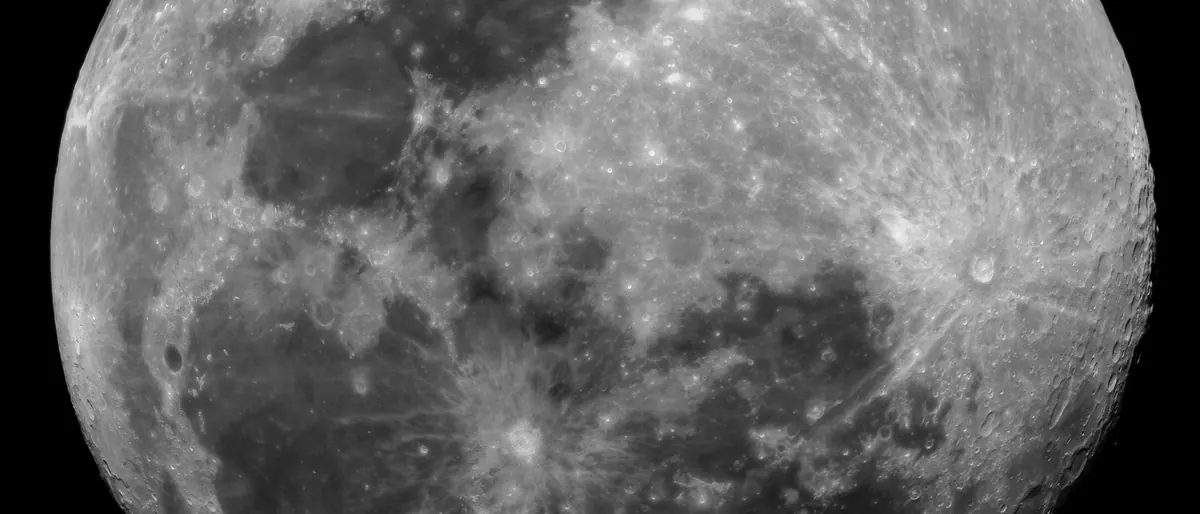
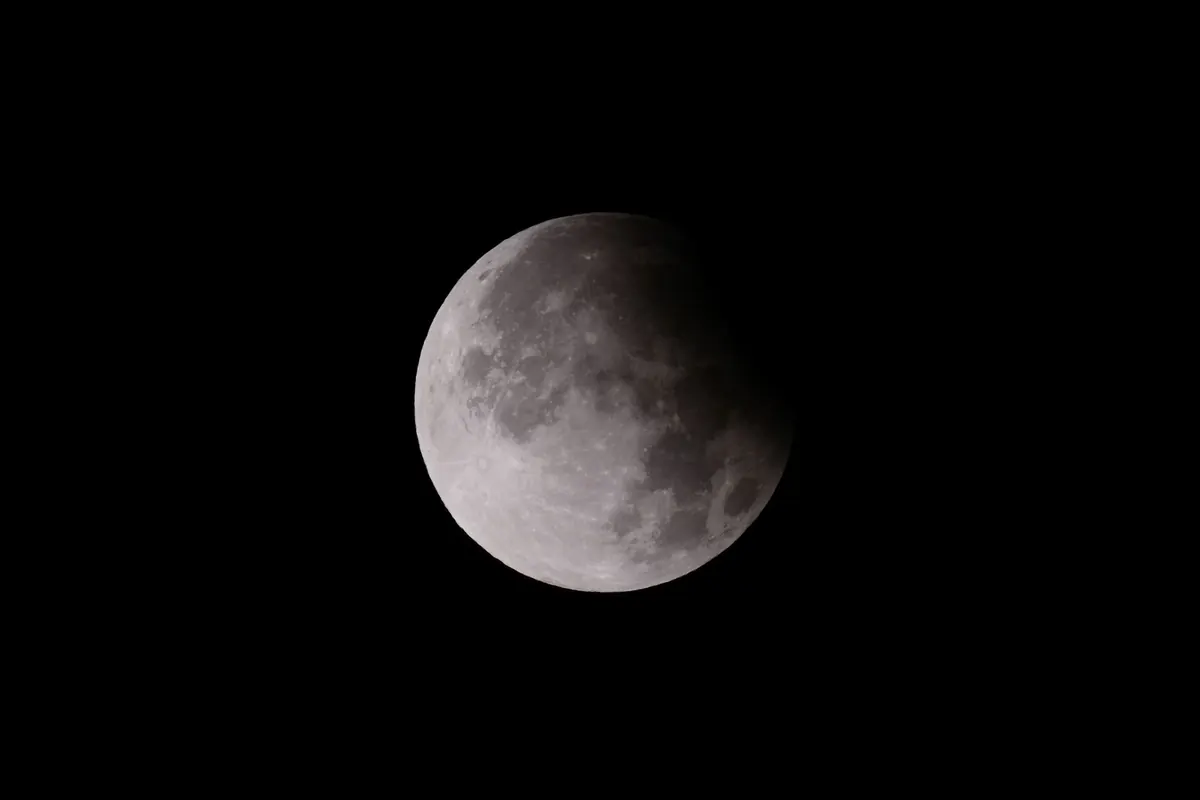
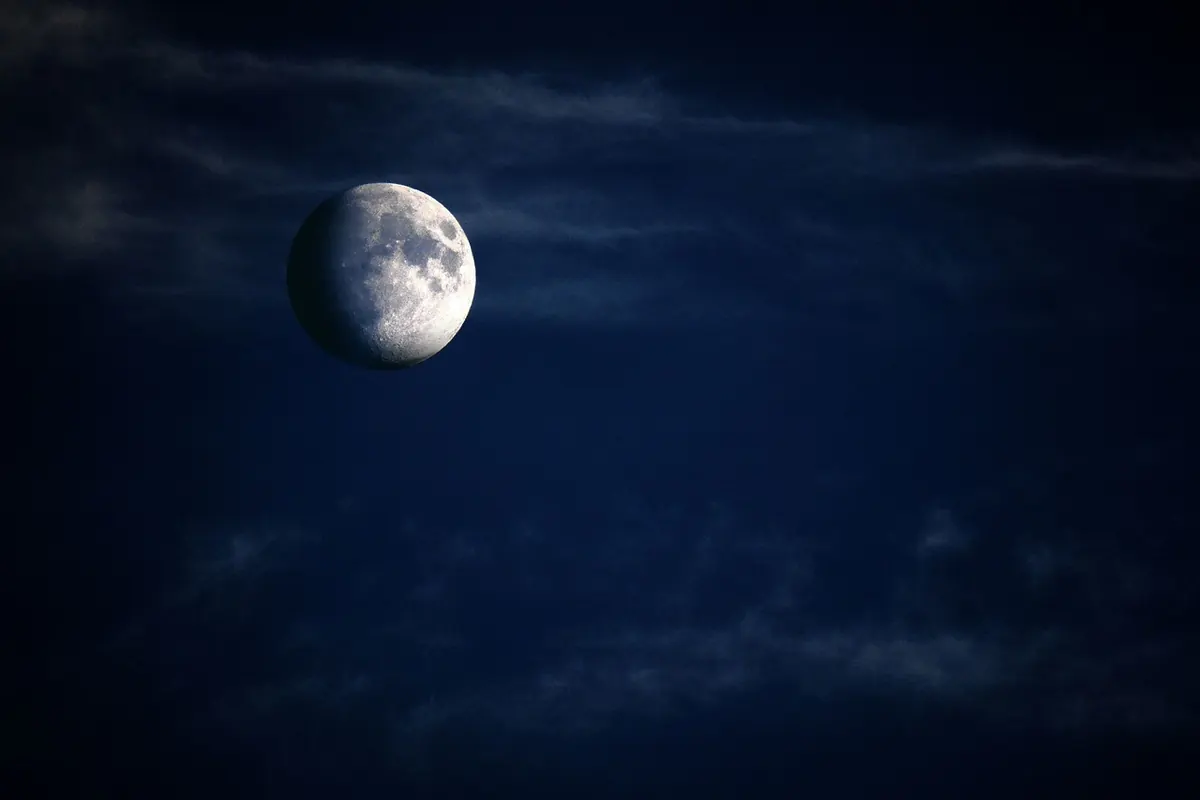
Step outside on any clear night when the Moon is past first quarter and you can read its face without a telescope. Dark grey patches sprawl across the left-hand side; brighter, rougher ground fills the rest. Most people learn the names — Sea of Tranquility, Sea of Serenity — and assume the dark areas are what they sound like. They are not water. They are flood basalt, and the contrast between those dark plains and the pale, cratered ground around them is the single most useful clue to understanding how the Moon built itself.
This is a beginner's guide to that contrast: what the two terrains are made of, how to tell them apart at the eyepiece, and what each one quietly records about the Moon's first billion years.
Two Colours, Two Kinds of Rock
The dark regions are called maria (singular mare, Latin for "seas"). The bright regions are the lunar highlands, sometimes called terrae. The difference you see is albedo — how much sunlight a surface reflects. Maria reflect only about a tenth of the light falling on them. Highlands reflect roughly twice that, which is why they look dazzling against the maria when the Moon is full.
The colour difference comes from chemistry. Maria are basalt: iron- and titanium-rich lava rock, dark in the hand and dense. Highlands are mostly anorthosite, a pale rock made largely of plagioclase feldspar — the kind of crust that floats to the top of a global magma ocean as it cools. In other words, the bright ground is the Moon's original skin, and the dark ground is what later poured out from underneath it.
The Maria: Where the Moon Flooded Itself
Maria cover roughly a sixth of the lunar surface, but about a third of the near side. That lopsided distribution is not an illusion — the far side has very few of them, and the reason is still argued over. The leading idea is that the near-side crust is thinner and richer in heat-producing elements, so it cracked and leaked more readily.
Their formation ran in three stages. First, giant impacts punched enormous basins into the crust — Imbrium, Crisium, Nectaris and others, hundreds of kilometres across. Second, tens to hundreds of millions of years later, magma rose along fractures and flooded those basins, sometimes in several separate episodes. Third, the lava cooled into flat plains, leaving only faint wrinkles and low ridges where the crust sagged under the weight.
Those buried lava sheets are heavy enough to measurably tug at orbiting spacecraft, which is how we know about the mass concentrations, or mascons, beneath them. The basalts themselves date from roughly 3.1 to 3.9 billion years ago — young by lunar standards, and far younger than the highlands.
What a mare looks like up close
Under binoculars or a small telescope, maria are conspicuously smooth and noticeably poor in craters. You will see a few large ones, some wrinkle ridges, and dark "haloes" around young craters where fresh ejecta has not yet been darkened by space weathering. The overall impression is of a flat, quiet surface — because it is one.
The Highlands: Bright, Old, and Beaten Up
Highland terrain looks like a battlefield photographed from above: overlapping craters on every scale, sharp mountain ranges such as the Apennines and the Leibniz Mountains, and long bright rays streaking out from young impacts like Tycho and Copernicus.
This ground holds the Moon's oldest rocks, formed around 4.4 billion years ago and possibly earlier. It also holds the record of the heaviest bombardment the inner solar system experienced. Because the highlands are so old, they have had far longer to accumulate craters, and in many places cratering has reached saturation: new impacts destroy as many craters as they create, so the surface stops looking any more crowded.
The pulverised layer on top — the regolith — is deeper here than in the maria. Apollo seismic instruments found a few metres of rubble over the basalts, and considerably more over the highlands, built up over billions of years of impacts, each one throwing a blanket of debris across its surroundings.
A Field Checklist for Telling Them Apart
With a modest telescope, a handful of quick tests settles the question in seconds:
- Brightness: dark and uniform usually means mare; pale and mottled means highlands.
- Crater density: crowded with craters means old highland crust; sparse means flooded basalt.
- Texture: smooth plains, wrinkle ridges and few relief features point to lava; hummocky, hilly ground points to highlands.
- Edges: maria often have a clear, lobed boundary where lava met higher ground; highlands rarely do.
- Rays: bright streaks spreading from a crater are fresh ejecta, found on both terrains but most obvious over highlands.
Try this on the boundary between Mare Imbrium and the Apennines, or where Mare Tranquillitatis meets the highlands to its south. The transition is abrupt, almost like a shoreline, and that is exactly what it is — not of water, but of lava that pooled against higher crust and then stopped.
What the Contrast Explains
Put the two terrains together and you get a rough timeline of the Moon's thermal life. The highlands record a hot, violent youth: a magma ocean, a floating anorthositic crust, and relentless impacts. The maria record the long cooling that followed, when the interior was still warm enough to melt rock on a vast scale but the crust had thickened and stiffened.
Crater counting turns this into a dating method. Because impacts accumulate at a broadly predictable rate, a surface with few craters must be young and one with many must be old. Draw a boundary on a photograph and count craters on each side, and you can reproduce, in a rough way, the reasoning that pinned down mare ages long before any sample was returned.
The returned samples confirmed it. Apollo 11 landed on Mare Tranquillitatis and brought back basalt. Apollo 16 landed in the Descartes highlands and brought back anorthosite and impact breccia. The two terrains really are two different libraries of rock.
Start With Binoculars Tonight
You do not need equipment to begin. Go out when the Moon is around first quarter and look with your eyes alone: the dark patches form a recognisable pattern, and half of them are maria. Then pick up any pair of binoculars and steady them against a wall or fence post.
Two viewing conditions do different jobs. Near full Moon, the contrast between dark maria and bright highlands is strongest, which is the best time to learn the map. Along the terminator — the day-night line — low sunlight throws long shadows and reveals relief, so the highlands look mountainous and the maria look flat. Use both, on different nights.
Print a labelled lunar map and keep it beside you. Sketch what you see rather than just looking: the act of drawing forces you to notice which side of a boundary has craters and which does not. Start with three features — Mare Tranquillitatis, Mare Imbrium, and the southern highlands — and work outward from there.
Within a few sessions the Moon stops being a bright disc with smudges on it. It becomes a place with a history written in two colours: the pale, battered crust that survived, and the dark lava that buried part of it.
Photo: Dennis Ariel / Pexels