October 17, 2026
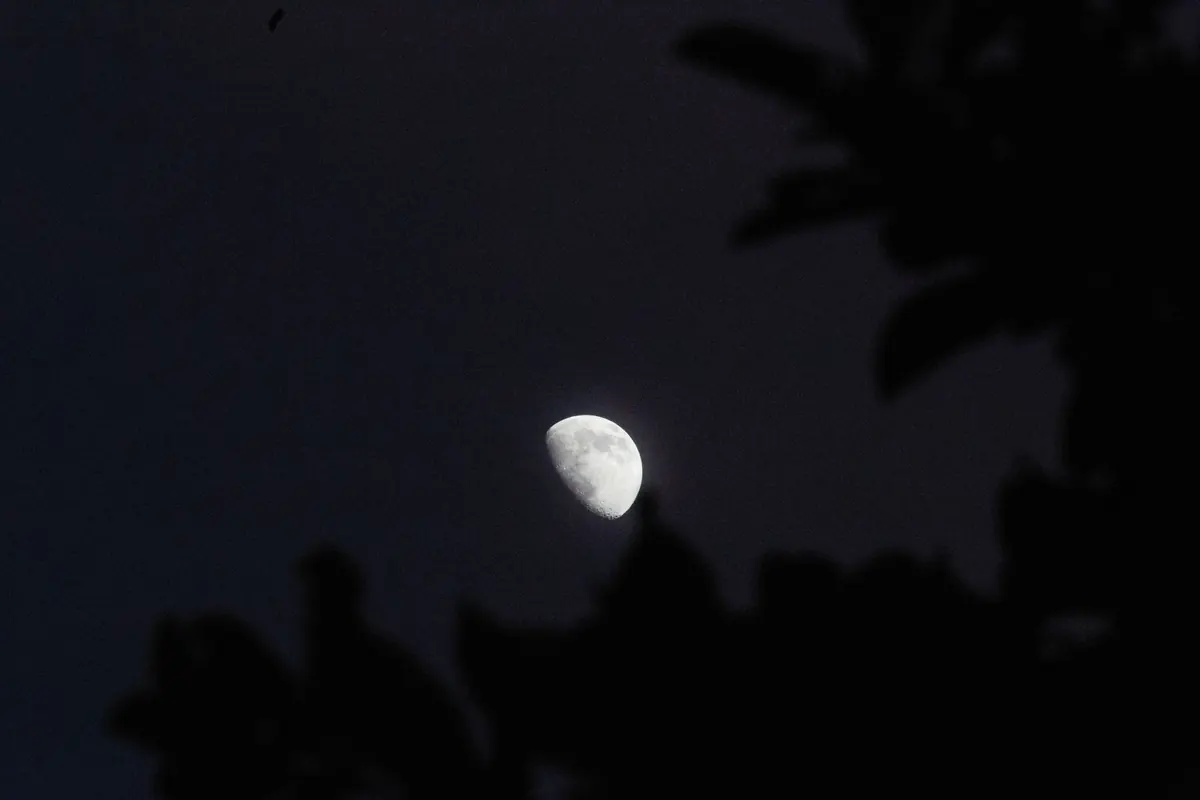
Stand outside on a clear night in Sydney, Cape Town or Santiago and look up at the Moon. If you learned its face somewhere north of the equator, something feels off. The big dark plains sit low on the disc instead of high. The bright cratered highlands have swapped ends. It looks as though someone unhooked the Moon, turned it over and hung it back up.
Nobody did. The Moon is doing exactly what it has always done. What changed is the platform you are standing on, and the direction your particular patch of ground insists on calling "up".
The Moon Is Fine — Your Sky Is Tilted
"Up" is not a property of the universe. It is a local direction, defined by gravity pulling at the soles of your feet. Your zenith — the point directly overhead — aims at a patch of space that depends entirely on where on Earth you are standing.
Two observers, one in London and one in Cape Town, are not standing side by side looking at the same picture. They are standing on opposite shoulders of a sphere, tilted away from each other by many degrees, with their zeniths pointing in quite different directions. The light arriving from the Moon is identical for both. The frame they measure it against is not.
A useful experiment: hold a photograph at arm's length and slowly tilt your head to one side. The photograph has not changed. Not one pixel. But your idea of which way is up has, and so the picture appears to rotate. The Moon is the photograph. Your horizon is your head.
Which Pole Is Above Your Horizon
Here is the heart of it, and it is surprisingly simple.
Astronomers measure the orientation of anything in the sky against the celestial poles — the points where Earth's axis, extended outward, meets the sky. In the Northern Hemisphere, the north celestial pole sits above your horizon at an altitude roughly equal to your latitude. In the Southern Hemisphere, that pole is below the horizon, and the south celestial pole takes its place overhead.
That single fact does almost all the work. For a viewer in Europe or North America, "celestial north" points upward in the sky. For a viewer in Australia or southern Africa, celestial north points downward. The Moon's north pole is above its features in both cases, but one observer sees that orientation pointing up and the other sees it pointing down.
The Moon is not upside down. You are looking at the same object from a different side of a rotating sphere, and your local vertical has swung around with you.
How Much Rotation You Actually See
The familiar shorthand — that the Moon appears flipped 180 degrees south of the equator — is a good rule of thumb rather than an exact number. The true angle between two observers' views depends on several things at once.
- How far apart your latitudes are. Two observers at similar distances from the equator, one north and one south, typically see the disc rotated by something close to a half turn. Two observers both in the same hemisphere see a much smaller twist.
- Where the Moon sits along its path. The Moon follows a track close to the ecliptic, and its position along that track changes its orientation relative to the horizon.
- The time of night. The Moon rotates relative to your horizon as it crosses the sky, so a view at moonrise and a view at moonset are not the same picture.
- The season. The angle the ecliptic makes with the horizon shifts through the year, which tilts the crescent differently in June than in December.
So treat "upside down" as a description of the impression, not a measurement. The impression is real and reliable; the exact figure is not fixed.
What Actually Changes — A Quick Checklist
If you want to compare notes with someone in another hemisphere, here is what to look for.
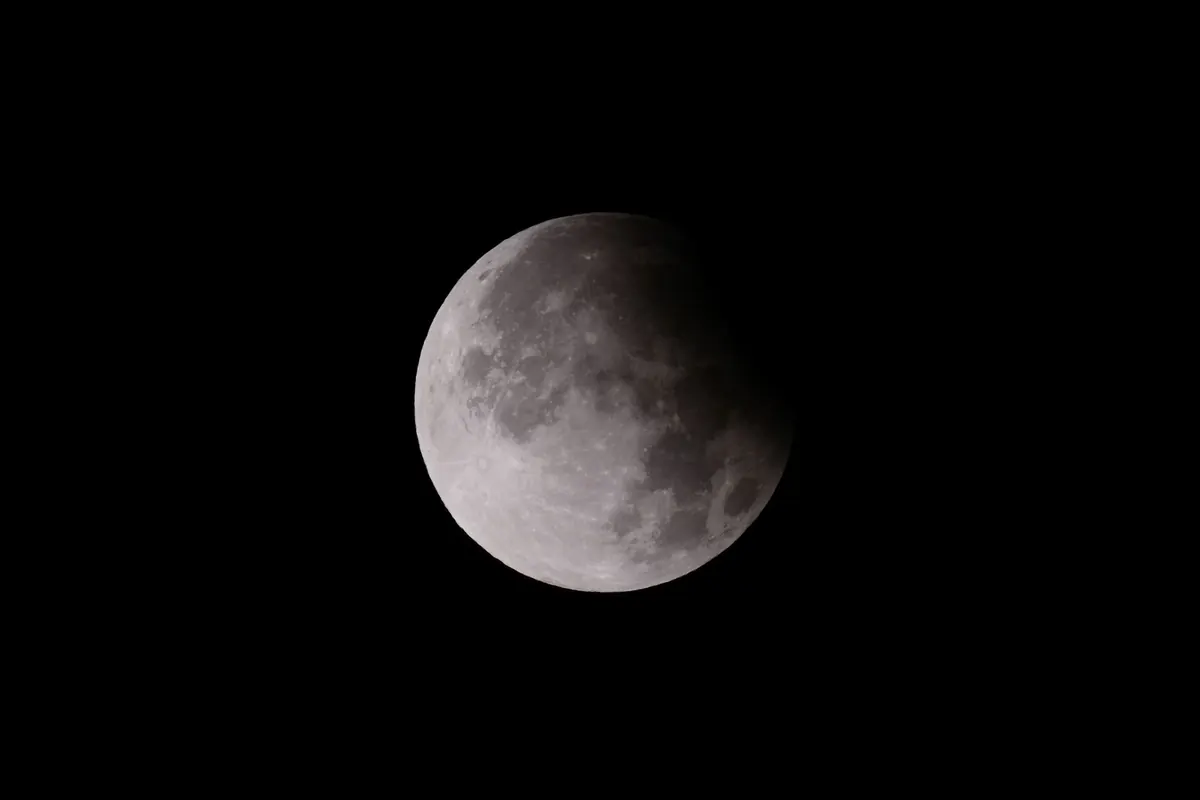
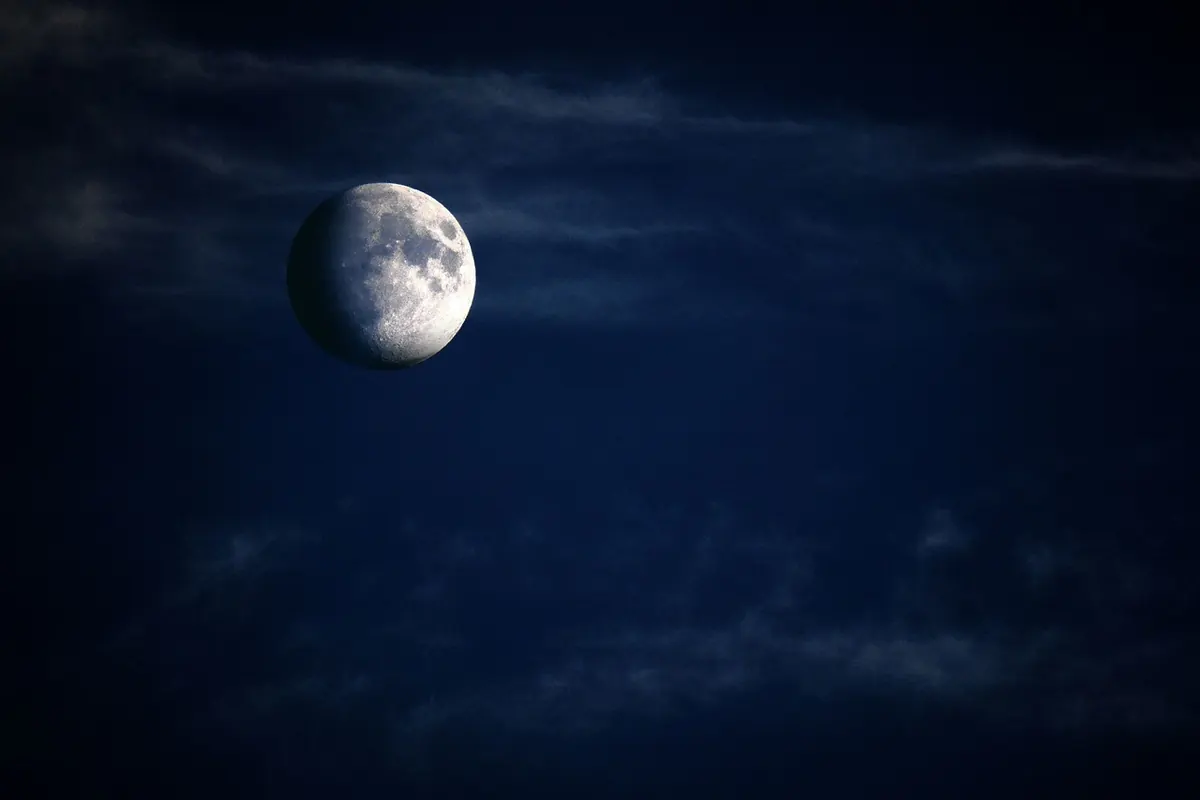
- The maria. The large dark plains — Imbrium, Serenitatis, Tranquillitatis — cluster toward the top of the disc on a typical northern evening. From the south, the same patches gather near the bottom.
- The lit limb. A waxing Moon is illuminated on the right-hand side as seen from the Northern Hemisphere and on the left-hand side as seen from the Southern Hemisphere. Waning reverses both.
- The direction of travel. Facing roughly south from mid-northern latitudes, the Moon drifts from left to right across the sky. Facing roughly north from the south, it drifts from right to left.
- The tilt of the horns. Crescent horns always point away from the Sun, and the angle they make with the horizon changes with latitude and season.
- What does not change. The phase, the apparent size, the pattern of craters. Those are properties of the Moon and the Sun, not of your address.
Why the Crescent Sometimes Looks Like a Bowl
Travel near the equator and the crescent starts behaving oddly. Instead of standing upright like a boat, it can lie almost flat, lit along the bottom edge, grinning up at you like a smile.
The reason is geometric. Near the equator the ecliptic — the path the Sun and Moon roughly follow — meets the horizon at a steep angle, close to vertical. The lit side of the Moon faces the Sun, and when that direction points almost straight down, the crescent tips over onto its back. Further north or south, the same ecliptic meets the horizon at a shallower angle and the crescent stands more upright. Keep watching through the year and you will see the shape shift as the angle changes.
Watch It Roll During a Single Night
You do not need to travel to see the effect in action. It happens above your garden.
Because your horizon rotates as Earth turns, the Moon appears to roll slowly relative to landmarks, trees and rooftops. It is not spinning on its axis any faster than usual — it is tidally locked and always shows the same face. Your frame of reference is what rotates.
Set up a camera on a fixed tripod, take a picture every half hour, and compare the frames. The Moon will look visibly tilted by the end of the evening. That same slow roll, multiplied over thousands of miles of latitude, is what makes the view from the other hemisphere seem so unfamiliar.
How to See the Flip for Yourself
This is easy to test, and doing it yourself is far more convincing than taking anyone's word for it.
- Pick a clear night with a visible horizon. A waxing or waning crescent is best, because the horns make the tilt obvious at a glance. A full Moon works too — look at the maria.
- Sketch, don't just stare. Draw a simple horizon line, add a rooftop or tree as a reference, and mark where the dark patches sit. Memory is unreliable; paper is not.
- Note the time and the phase. Write them down next to the sketch. Two drawings made a month apart at different phases will not be comparable.
- Take a photograph. Even a phone shot through a steady hand, braced against a wall, will capture the orientation well enough for comparison.
- Find a counterpart. Ask someone in the opposite hemisphere to photograph the same phase on the same night. Line the two images up side by side and the rotation is unmistakable.
- Use a planetarium app as a control. Set the location to a southern city, set the date and time, and look at how the Moon is drawn. Then set it back to your own location. Watching the disc swing round on the screen shows the geometry more clearly than any diagram.
Do this once and the puzzle dissolves. The Moon keeps its face to us with stubborn consistency. It is the ground beneath us that keeps turning, and the sky we see is always painted from wherever we happen to be standing. Look up from the other side of the world, and the same familiar object is waiting — just hung from a different hook.
Photo: Alexey Demidov / Pexels