October 21, 2026
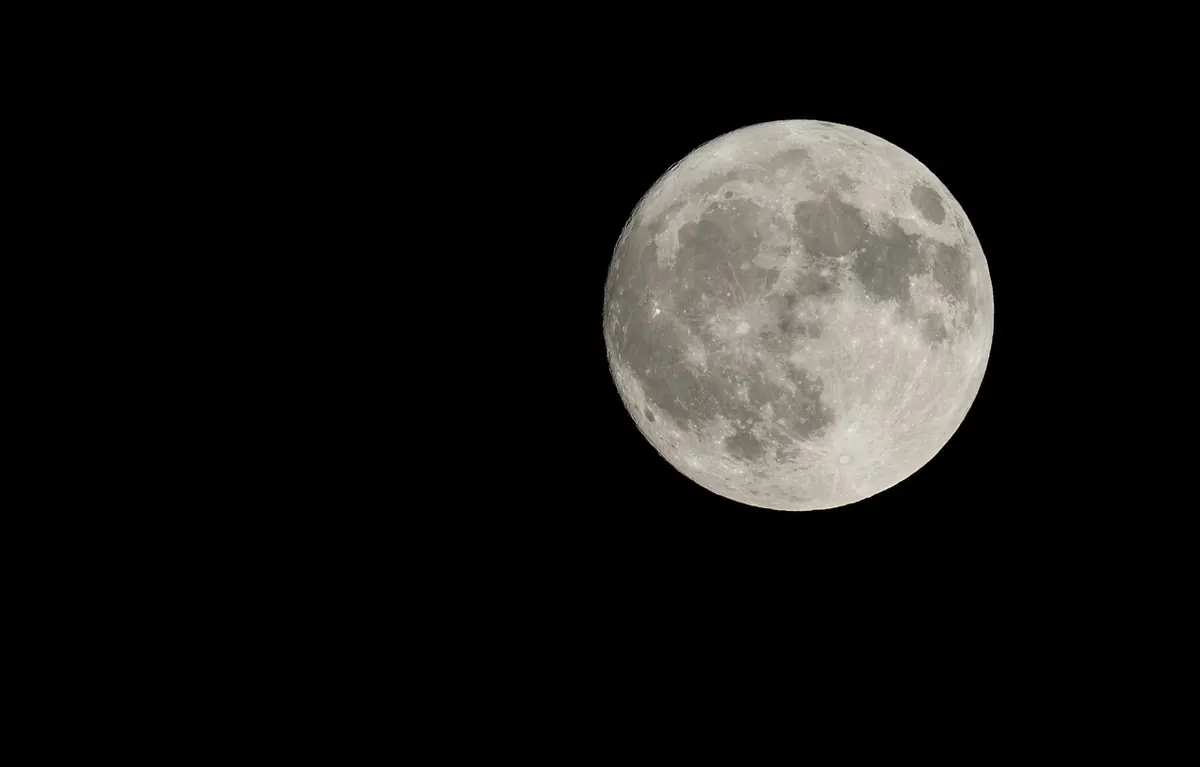
The first thing to know about looking for Apollo 11 from your backyard is that the Moon does not cooperate with movie expectations. You will not see a flag, a lander, or a trail of footprints. What you can see is the place: the Sea of Tranquility, a broad dark plain that held Tranquility Base on 20 July 1969. With a modest telescope and a little patience, you can trace the craters around that patch of lava and stand, in a sense, exactly where the mission landed. The hardware is another matter.
The Resolution Wall: Why the Hardware Vanishes
Magnification is the wrong tool for this job. A telescope can enlarge an image until it fills the eyepiece, but it cannot create detail that the aperture and the atmosphere never delivered. What matters is resolution: the smallest angle a telescope can separate. A typical 6-inch reflector under good skies resolves about 1 arcsecond. At the Moon’s distance, 1 arcsecond is roughly 1.9 kilometres on the lunar surface. The lunar module’s descent stage is only about 4 metres across. It is not a small target. It is an impossibly small target.
A question of angular size
The descent stage subtends something like two-thousandths of an arcsecond from Earth. To resolve that, you would need a mirror tens of metres across, above the atmosphere, and a night of perfect seeing. No backyard telescope comes close. Even a large amateur Dobsonian that shows beautiful craterlets and rilles will render the Apollo 11 site as an unmarked stretch of grey. The flag is smaller still, and the footprints are smaller again. They exist. They are simply beyond the reach of Earth-based optics.
The landing site is a place to locate, not a monument to resolve.
What You Can Actually See
Mare Tranquillitatis is one of the easier lunar seas to identify. It sits on the eastern side of the Moon’s disc, a wide dark basin north of Mare Fecunditatis and east of Mare Serenitatis. Naked-eye observers see it as a smooth grey patch. Through a 3- or 4-inch telescope at around 100x, the surrounding craters begin to appear. Sabine and Ritter lie to the west of the Apollo 11 site; Moltke, a smaller crater, lies to the south. When the terminator is nearby and shadows are long, these craters show clean rims and dark floors. Near full Moon they flatten into faint rings.
The Apollo 11 site itself is about 0.7° north and 23.5° east, in the southwestern part of the sea. It has no crater, no scar, and no dark stain to mark it. That is part of the difficulty. You are looking for a coordinate on a lava plain, not a feature. The reward is contextual: you can see the terrain the crew crossed, the craters they used as landmarks, and the broad basin that made the landing possible.
Finding Tranquility Base: A Practical Route
Use a lunar map or a reliable Moon app. Printed atlases work well, but an app that flips the view to match your telescope is faster. Then follow a simple route:
- Wait for a night when the terminator is within a day or two of Mare Tranquillitatis. That usually means a few days after first quarter or before last quarter, depending on libration and your hemisphere. The shadows will define the craters.
- Find the Sea of Tranquility. Start with the naked-eye Moon, then move to your finder. The sea is large enough that you can confirm it at low power.
- Identify Sabine and Ritter on the western side of the sea. They are the paired craters that anchor the region.
- Move east-southeast toward Moltke. Tranquility Base lies in the smooth plain north of Moltke and east of Sabine and Ritter.
- Increase magnification gently. Once you are at 150x or 200x, centre the empty patch between those landmarks. That is the landing region.
Do not expect a eureka moment. The site is subtle. A sketch helps more than a photograph, because sketching forces you to study the crater rims and the subtle tonal changes in the mare. If you keep a log, note the phase, the seeing, and the magnification. Over several months you will learn the region well enough to find it without a map.
Equipment and Technique That Help
You do not need a large telescope. A well-collimated 4- to 8-inch instrument is enough to see the surrounding craters and the shape of the sea. What matters more is steady air and a patient eye.
- Let the telescope cool. A warm mirror or lens produces mushy images for the first half hour.
- Use a moon filter or variable polariser. The Moon is bright. Cutting glare helps you see low-contrast boundaries.
- Observe when the Moon is high. Lower altitude means more atmosphere and worse seeing.
- Try video stacking. A simple lunar camera and free stacking software can pull out crater detail that your eye misses in real time.
- Keep magnification sensible. If the image is boiling, back off. Empty magnification never reveals Apollo hardware.
Myths, Photos, and the Flag
Orbital photographs show the landing sites because the cameras are close. That is not the same as looking through a backyard telescope. Images that claim to show the flag from Earth are either composites, mislabelled orbital crops, or shots of unrelated craters. The flag itself was a simple nylon sheet on a metal rod; it has been exposed to decades of sunlight, micrometeoroids, and temperature extremes. Even if it were pristine, it would be far below the resolution of any amateur instrument. The same goes for the descent stage, the experiment packages, and the abandoned equipment.
A Realistic Night at the Eyepiece
Plan for a quiet session rather than a dramatic reveal. Check the phase, let your scope cool, and spend ten minutes at low power learning the Sea of Tranquility. Then push the magnification and find Sabine, Ritter, and Moltke. Centre the blank plain between them. You will not see Apollo 11. You will see the place where it happened, and that is a more honest and more interesting sight than a manufactured close-up. The Moon keeps its hardware hidden, but it gives up the landscape readily enough.
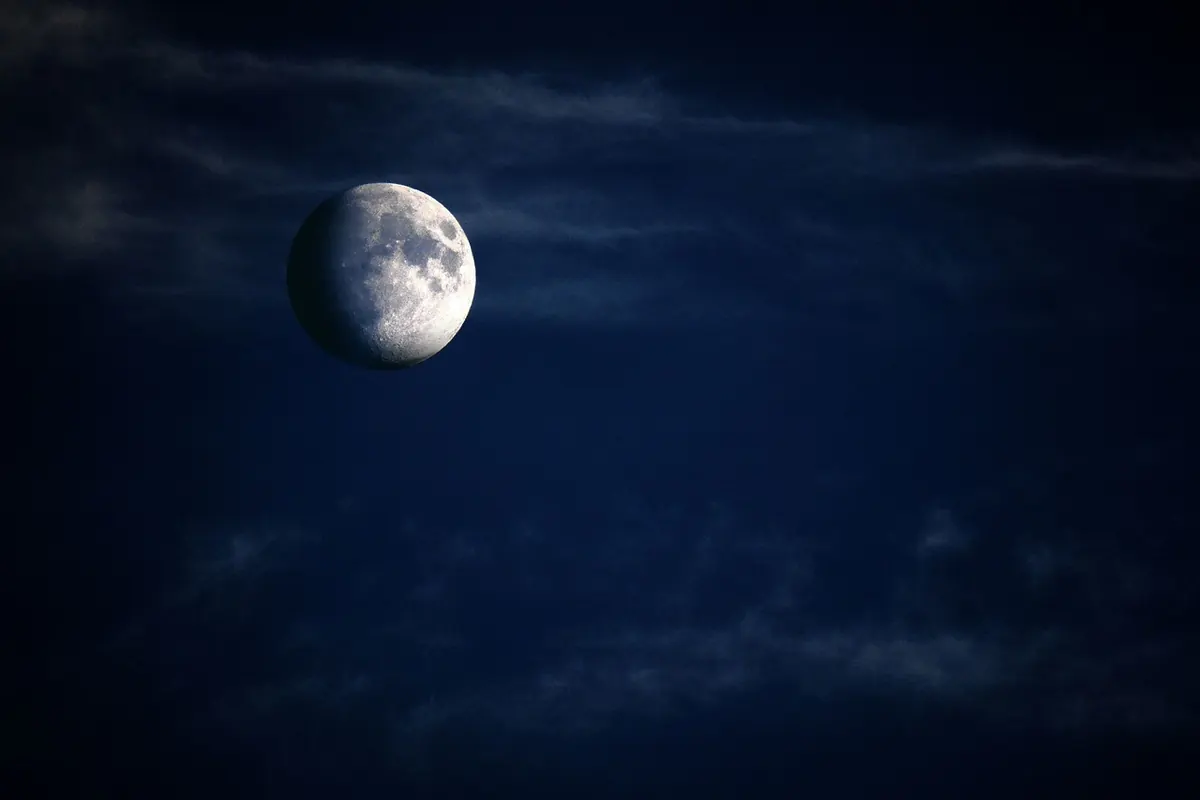
Photo: lukasbieri / Pixabay